
About FaburAI
Governance built for the estate you actually have.
Enterprise IT has never centralized, and the AI estate is fragmenting faster than anything before it. FaburAI is built on the conviction that this is permanent — that governance has to reach the estate where it already lives, distributed and heterogeneous, rather than wait for a consolidation that never arrives.
Estates do not centralize. They accumulate.
Every wave of enterprise architecture has promised consolidation and delivered more variety. Warehouse, then lake, then lakehouse. One cloud, then several. The consolidation programs rarely fail outright — they get outrun, because new systems arrive faster than old ones retire.
Acquisition imports a stack
Every acquisition brings an entire estate with it: its own identity model, its own data platform, its own conventions. Integration is measured in years, and the next one usually arrives first.
Residency forbids it outright
In a growing number of jurisdictions, moving everything into one place is not merely difficult but unlawful. Distribution is a legal requirement before it is an architectural preference.
AI is the sharpest version yet
Agents are adopted team by team, from the bottom up, faster than any central function can standardize them. The AI estate is being built by more people, in more places, more quickly than the data estate ever was.
Which leads to the conclusion the whole company is built on. A control that requires centralization requires the world to change first. A control that assumes heterogeneity works on the estate you have today.
The conviction and the engineering are the same decision.
If heterogeneity is permanent, a governance layer cannot be a place that traffic goes. It has to be something that travels to where the traffic already is. Every architectural choice below follows from that one sentence.
Enforcement runs where the call happens
The decision point sits inside your own environment, alongside the agent and the tool. FaburAI is never in the request path, so governing something does not mean routing it through us.
One product, deployed any way you want
Hosted, in your own cloud account, or entirely on-premises including environments with no outbound connectivity. The same build in each — self-hosting does not mean a lesser version.
Decisions are made locally
Policy is evaluated against a bundle already retrieved, so a governed estate keeps working on the last known good policy even when it cannot reach us.
The estate is discovered, not declared
You cannot ask a heterogeneous estate to register itself accurately, so the inventory is built from what is actually there — including AI actors nobody enrolled.
Govern what AI reaches, on whose behalf, and at what cost.
Four surfaces over one estate model. They are not separate products bolted together — each one is a view of the same graph of actors, tools, data and the paths between them.
AI Connect
Discover the distributed AI surface — the servers, tools and actors already in the estate.
AI Catalog
The canonical inventory of what is governable, down to the individual data column.
AI Control
The AI Graph, path-based policy, an approval gate, and enforcement at the edge.
AI Cockpit
The runtime record: every governed decision, and what it consumed.
The name, the line, and the blade.
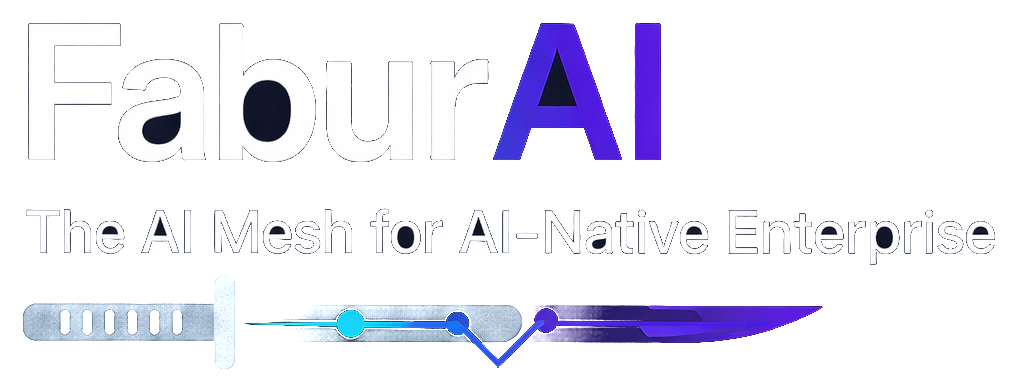
The lockup is three parts and they ship together — a wordmark, a line beneath it, and a katana. Each one says the same thing a different way.
FaburAI FAB-uh-rye
Short for the Fabric of the Future of AI, and pronounced to rhyme with samurai. A fabric is a weave of connections rather than a single point — which is the shape we think governance has to take, and the reason the word is in the name.
The AI Mesh for AI-Native Enterprise
The line beneath the wordmark. A mesh is what a control becomes when it is distributed rather than central: many enforcement points across the estate, one shared model of what is out there, and nowhere that traffic has to funnel through. It describes a shape, and the shape is the argument the rest of this page makes.
The blade is the product
The katana is part of the logo rather than an ornament placed beside it. The blade carries a line of connected nodes — agents, tools and servers joined into a graph of relationships. It is the same statement the name makes, made visible.
The three parts reinforce each other on purpose. Samurai and FaburAI, mesh and graph, katana and connected nodes — one idea, said three ways.
FaburAI, Inc.
A Delaware corporation, privately held and independently operated. FaburAI builds one thing and builds it deliberately: the governance layer for an AI estate that will never sit in one place.
- Legal entity
- FaburAI, Inc.
- Jurisdiction
- Delaware, USA
- What we build
- Runtime governance for the distributed AI estate
- Where enforcement runs
- Inside the customer environment, never in the request path
What there is to know about the platform is on this site, stated at the level of what it does and how. Where a claim can be checked, we would rather you checked it.
Start with the estate you are trying to govern.
The most useful conversations begin with what is already running and what nobody can currently account for.